I remember when the Broadway musical Fiddler on the Roof came out. And, a few years later, the blockbuster movie with Zero Mostel. I remember being rather baffled, wondering who would name their kid “Zero?!” Especially when I felt like one. Fortunately, young Zero grew up to become a great and well-loved actor. And I did not remember a popular movie being – like Fiddler, all about Jewish themes. It was amazing and validating. Dad loved singing the songs, “If I were a rich man, dibby, dibby, dibby, dibby, dibby, dibby dum!” I think they brought out the best in him, and he was never quite so jolly as when he was Tevye. He would belt out, “Tradition!” Making it sound as if tradition were a fun thing.
Lately, I’ve found myself thinking about intergenerational transmission and tradition. When taken simply as barren verbs, void of content, they are similar; both are a repeated bequest through generations keeping alive across time of something. However, one might be intentional, richly ritualized, and even sacred, while the other laden with meanings. The other is compulsive, dysregulated, or perhaps unconscious, even destructive and lethal. Each makes the dogged journey through time. And as we know all too well, they can readily spill and mingle into some of the horrible legacies that, due to ancestral roots, can be hardest to excise and extinguish.
Being the child of two Holocaust survivors, who also each had their own iterations of profound neglect, I have been the heiress to a bounteous bequest of both. For so many reasons, I feel like a zealot in bringing awareness to and breaking the chains of intergenerational transmission. And the dysregulation of neglect, as it moves through generations, wreaks havoc of all kinds. It is complicated, however, the blur between legacy and curse. My father’s ferocious tenacity and determination are one of my most cherished gifts from him and certainly got me up some of the steepest climbs on my bike and some of the most daunting deadlines for my writing. It certainly also brutalized me growing up. And this is often a tangled mess inside of me.
My overwhelmed nervous system adapted by rejecting most traditions as soon as I was old enough to make my own choices. Interestingly, however, all of the songs have stayed deeply grooved in the playlist of my hippocampus and visit uninvited often. When asked to write about the intergenerational transmission of trauma recently, what immediately popped up in my mind’s ear was a song I had not thought of in years, “L’dor Va Dor,” from generation to generation. I never even liked that song!
One of the most vicious expressions of dysregulation during my childhood was an eating disorder that almost took me down at age 12. I was anorexic in 1966-67, when there was little information about, let alone help for it, and a poverty of any understanding. Perhaps I was, in some way, trying to replicate my parents’ holocaust trauma or suffer enough to be worthy of existence. Who knows? But somehow, I was neglected enough to slip quietly under the radar so I could “do what I wanted.”
One well-honed anorexic trick was controlling food as much as possible by taking over the household cooking, which my mother was more than happy to have me do. So, I learned to cook. I made chicken soup every Friday – from scratch. I learned how to roast a chicken to perfection. I learned to make challah and even bagels. I am grateful for this, as these have become the bequests, the gifts of inheritance I have retained. And whatever little bit of tradition that I keep to this day (now that I am blessedly free of eating problems after decades of dogged recovery work) are the foods.
The Jewish tradition of sharing food (and “Jewish penicillin!”) is something I continue, something that gives me great joy. And something about sharing food, giving and sending it to people I love, gives me an odd sense of organic connection, as my “handiwork” goes into their bodies. The recipes that span historical epochs and diasporic geographic wanderings of millennia seem to connect me with my friends, far and near, and the best of my heritage. Sharing them was certainly a source of comfort and connection during the bitterest isolation of the COVID19 Pandemic.
The perils of intergenerational transmission are well known. Resonating to a dysregulated brain, or pulsing alone into empty space, makes for all sorts of adaptations or attempts at it for an infant and child. My eating disorder was but one of a coiling chain of attempts to include alcohol, sexual compulsivity, overwork, relentless exercise… Like a rat on a wheel, I kept at it. But my father’s determination commandeered me to stay the course in healing, and I ended up with a pretty wonderful life. And the kind of faith and hope in the power of healing that enables me to shepherd some number of others out of the woods with me.
I am committed to a no-blame paradigm. Certainly, neglect is a failure that often comes straight out of the trauma experience. It is a failure of attention, awareness, and aliveness that of course fails to transmit to the hapless infant. It is not excusable, nor is it, the failure of at least attempting to heal. What would have happened if my mother had been blessed with the good therapy I have had? My father? What would my life have been, and theirs? We cannot know. But we must do better. And make safe, effective, and tenacious healing available, even while we strive to make a larger world that is safe, regulated, and regulating.
I’ve been facilitating trauma workshops for journalists for a couple years now, and at first, implementing trauma-informed practices seems daunting to every group. Many journalists work under pressure from tight deadlines and limited resources, so newfangled processes and considerations can understandably feel like piling more onto an already full plate.
By the end of a workshop, I’ve generally convinced the group that trauma-informed journalism is not only worthwhile, but possible. How do I win them over? I tell them it’s really not that hard.
To demonstrate the accessibility of trauma-informed journalism, I’ll share how my production team at Pizza Shark approached reporting on emotionally taxing public health topics like dismal carceral health care, systemic lack of mental health crisis resources, and disparities in disaster relief efforts for our new Audible original podcast, National Emergency.
Slow down (where you can):
At the height of production for National Emergency, everyone on the team was feeling the frenzy. The show is hosted by two incredible ER nurses in New York City, one of whom is also a nurse in a jail. Coordinating schedules for interviews and voiceover recordings was a round-the-clock task. Conducting the interviews brought up all sorts of difficult feelings – especially for our episodes on carceral health and the country’s astronomical Black maternal mortality rate.
Every week, we had a team meeting with a packed agenda. Quickly it became clear we were not prepared to dive in to said agenda at the start of each meeting, because everyone had so much to offload about the breakneck pace of our vulnerable interviews and voiceovers, and the heart-wrenching research that accompanied them.
We decided to start each team meeting with a short mindfulness exercise. The term “mindfulness” is off-putting to some people, many of whom I believe to be journalists, so we presented it without introduction – “OK, everyone. Before diving in, let’s pause for a second and take a few deep breaths together.” Our team members had the choice of closing their eyes or lowering their gaze while we inhaled through our noses for a count of four and exhaled through our mouths for a count of six. Or they could simply sit quietly and not do it at all.
While there was some hesitation to embrace the breathing, everyone reflected back on it as a helpful respite.
Talk about it:
Most of my teachings around trauma-informed journalism, and storytelling in general, center on clear communication of realistic boundaries and expectations for everyone involved. For example, before interviewing a trauma survivor, a journalist can give the person a heads up that the interview might bring up complex, difficult feelings, and that the interviewee might want to plan for aftercare once it’s over. That communicates a clear expectation of what it will be like to consent to an interview. A realistic boundary might be that the journalist won’t be able to console the interviewee post-interview, but will provide support by sharing which quotes from the interview are selected for publication, honoring the interviewee’s agency.
Although this is a standard way to interact with interviewees who are private individuals, the communication of these expectations and the boundaries surrounding them is rarely explicit. Making it explicit is what bumps this interaction up to a trauma-informed journalism practice.
Make space for feelings:
Traditionally, journalists are trained to be “objective” in their reporting, which often translates to an arms-length approach to individual interviewees’ experiences, including their emotional responses. The attainability – and desirability – of objectivity in journalism is increasingly debunked. For our purposes here, “objectivity” toward traumatized interviewees’ lived experience and emotional reality is conducive to retraumatization and exploitative journalistic practices – in other words, it is unethical.
ForNational Emergency’s episode on mental health care systems, we interviewed a woman who had been a patient in two psychiatric ERs. We made sure to start the interview with a check-in: Are you feeling up for this? Are our hosts feeling up for this? Please let us know if something feels unmanageable. Clear communication.
During the interview, we made sure to pause with her, asked if it would be OK to delve into XYZ, and at the end, we went over what the next steps of the process would be. Once our interviewee was gone, the production team stayed to debrief, commenting on whatever parts of the conversation had struck them the hardest. These moments of aimless conversation may or may not be editorially useful, but they are certainly helpful in carrying the emotional load of production.
National Emergency, a podcast about what happens when our national issues walk into the emergency room, is out now exclusively on Audible, produced by Pizza Shark.
Carolina Murriel is a writer, ceramic artist, audio journalist and death doula in New Orleans. She teaches trauma-informed clay building and storytelling, and she helps elders capture their legacies in the form of oral histories. Her and co-founder Isis Madrid’s award-winning podcast studio, Pizza Shark, works toward radical inclusivity in media. Carolina writes about family, immigration and living with complex PTSD and major depression on Substack.
Photo Credit: Audible National Emergency
By: Aneesh de Vos and Dr. Helen Douglas
By 2025, an estimated one billion of us will be going through menopause (Hill, 1996). The World Health Organisation, whilst recognising that it is a part of the continuum of life also considers that it is affected by societal and cultural norms (2022). In recent years, the topic of menopause has been discussed extensively and research is gaining traction. Research highlighting both menopause and adverse childhood experiences (ACEs) is in its infancy – a paper by Kapoor et al (2020) explores the correlation between the symptomology of menopause and the trauma response resulting in more burdensome symptoms. It further suggests a need for those who are experiencing severe menopausal symptoms to be screened for ACEs by their health care providers.
“My mental health started to rapidly spiral downwards, but no-one made the link between my history of CSA and menopause” (de Vos & Douglas, 2022).
If we consider that, “Emotions and physical sensations that were imprinted during the trauma are experienced not as memories but as disruptive physical reactions in the present” (van der Kolk, 2015, p.206) then it is not surprising menopausal symptoms can be mistaken for a resurgence of the symptoms of PTSD (de Vos & Douglas, 2022). A lack of a felt sense of safety can arise and exacerbate old patterns of feeling out of control in a body that no longer can be relied upon to respond in its usual way. The unpredictability of peri/menopausal symptoms can and do reflect the childhood experience of sexual abuse – “peri-menopause made me feel out of control, and that was triggering for me” (de Vos & Douglas, 2022). We believe that this is a fertile ground for shame to become further embedded – accentuating narratives of the past.
One in five women report being sexually abused as children (World Health Organisation, 2022) and that is only a reported figure. How many have not been reported? The isolation experienced through trauma in relation to childhood abuse where somatic changes occur (Herman, 1992) can be further exacerbated in the peri/menopausal response. A changed physical state can be confusing and frightening – even Freud reflected in his work, how the trauma response felt as if a person had been possessed (Bonaparte et al., 1954). The disconnect of how we knew our bodies to how are bodies are reacting creates the collision of trauma and menopause (Kemp, 2021; de Vos & Douglas, 2022).
“I experienced night sweats & panic attacks which I assumed were related to my PTSD. But it was peri-menopause” (de Vos & Douglas, 2022).
People who are working to adapt to their peri/menopausal bodies through medical or non-medical support are also affected by cultural messages (World Health Organization, Menopause, 2022). Whilst we can highlight the need for a wider conversation in the mainstream to be more compassionate towards peri/menopausal changes, those who have experienced CSA can often feel marginalised and judged within their culture (Ellis, 2020).
As this blog shows, CSA is prevalent globally and menopause can and does reignite PTSD symptoms. If we are to support the telling of the “secrets too terrible for words” (Herman, 1992, p.96) then we need to ask society to look beyond their own sensitivities and widen the peri/menopause conversation for all.
References:
de Vos, A. & Douglas, H. (2022) Online Inquiry: CSA survivors awareness of menopause. White Paper, p. 4-6. Dignified Menopause Global Initiative.
Bonaparte, M., Freud, A. & Kris, E. (1954) The Origins of Psychoanalysis. Letters to Wilhelm Fliess, Drafts and Notes; p. 1887-1902, trans. E. Mosbacher and J. Strachey. Basic Books. New York.
Ellis, K., (2020) Blame and Culpability in Children’s Narratives of Child Sexual Abuse. Child Abuse Review. Volume 28, Issue 6 p. 405-417.
Herman, J. (1992). Trauma and Recovery. The Aftermath of Violence – From Domestic Abuse to Political Terror. Basic Books.
Hill, K. (1996). The demography of menopause. Maturitas p. 113-27.
Kapoor, E. Okuno, M. et al. (2020). Association of adverse childhood experiences with menopausal symptoms: Results from the Data Registry on Experiences of Aging, Menopause and Sexuality (DREAMS). Maturitas, Elsevier.
Kemp H.F. (2021). Surgical Menopause: Not Your Typical Menopause. Flying Stoat Books, UK.
van der Kolk, B. (2014). The Body keeps the Score. Brain, Mind, and Body in the Healing of Trauma. Penguin Books, New York.
Aneesh de Vos and Dr Helen Douglas are independent researchers who also provide training for the helping professions on the subject of “The Collision of Trauma and Menopause”. Their book, under the same name, is due to be published in 2024. Their holistic approach explores the impact through a psychosocial lens, creating a discourse to further deepen awareness of the relationship between trauma & peri/menopause.
Aneesh is currently studying for her Doctorate in Psychological Trauma. She is an established therapist and supervisor who specialises in trauma. Helen’s Doctorate is in endocrinology, and she writes widely on menopause. In this blog they explore the effects of peri/menopause specific to a history of childhood sexual abuse (CSA).
By Erica Hornthal, LCPC, BC-DMT
Resilience is often seen as the capability to ‘bounce back’ or overcome difficult circumstances -it is essentially elasticity of the mind. Beginning with the mind can be challenging for many, so taking a bottom-up approach using movement can make all the difference. Starting with the body essentially allows us to literally move through challenges.
When you expand your movement and the aesthetics of that movement, you create more elasticity in the body. The mind and body are connected, so elasticity in the body leads to elasticity of the mind. The more movement you have at your disposal, the greater your ability to move through stressors in your life, or at the very least, just keep moving even in the face of adversity.
When we expand our movement vocabulary—all the movement at our disposal—we increase our emotional resilience. I like to call this diversification of movement. When you diversify your movement, you broaden your body’s ability to access a range of emotions, as well as your ability to manage them. Emilie Conrad, founder of the Continuum Movement, said, “The more capable a system [body] is, the more it’s able to manage whatever comes its way.” We want the body to be able to move safely in as many ways as possible to access a sense of safety in as many ways as possible.
Three steps you can take to change your relationship to movement to support resilience are:
Bring awareness to our movement.
We are always moving, but so much of it is unconscious; becoming more aware of our body requires us to pay attention. We are already using our phones right? We can make it work for us! Set a reminder or alarm on your mobile device to check-in with your body. How does it feel? What sensations do you notice? How are you currently moving?
Challenge our movement.
Engaging in the same movement pattern or habits doesn’t do anything for our body or mind. It can reinforce the “stuck” feeling we may already be experiencing. Challenging our movement is not about making it more difficult. Instead it is about making it uncomfortable. It is in the discomfort where we grow and change. Try a new way of moving, switch positions, and “shake” it up! Notice what movement is safe and comfortable and invite in the possibility or potential for something out of your comfort zone. Sometimes just the thought of this can bring on anxiety. It is important not to push yourself but again challenge even the idea of new and different movements.
Write it down.
Keeping a journal may not be one’s cup of tea, but it can be a great way to create awareness and support our mental health. We can participate in the Body Awareness for Mental Health Journal by asking ourselves these three questions:
What is one sensation I feel in my body right now?
How does or will this (sensation) impact my mental health?
How can I manage or address this (sensation) to support positive mental health?
*** Here is my example:
I am feeling tension in my shoulders.
Tension in my shoulders usually means I am overwhelmed and taking on too much.
I will be careful not to add any more tasks to my schedule and set aside time to connect with myself through a self-care practice (ex: hot bath, quiet time, dance, or yoga).
Try this in the morning to start your day; setting an intention and paying attention to your movement and body will help hold you accountable before the business of the day sets in. You can also use a journal to keep track of how you are challenging your movement and how your body awareness changes.
Resilience is like a muscle that can be strengthened. Here are 5 movement interventions to help get you started in building a more robust movement vocabulary.
Breathe.
Breath is a an autonomic movement that everyone engages in every day. Breath awareness is such a simple way to tap into the present moment and reconnect to the self. Breath awareness enhances resilience because it teaches us that we can move through any situation- the rise and fall of the chest and the expansion of the rib cage- each reinforce that the body is capable of moving through and beyond. Not to mention that a deep belly breath signals the rest and digest reflex, allowing us to find calm and peace.
Stretch.
Exploring the space that we take up and the space around us allows us to move through constriction where we often embody fear and anxiety. When the body expands, so does the mind, paving the way for new perspectives.
Diversify movement.
The more we move and challenge our movements, the more elastic and flexible our minds become. Our minds and bodies are connected, yet it can be difficult to change our minds. We can start in the body by increasing our movement vocabulary- the movements we have at our disposal- which supports new perspectives and helps us to recognize others’ points of view. Trying a new form of exercise, changing the speed of our movements, and engaging in improvisational movement are just some ways to encourage new movement patterns in our bodies.
Find quiet time for reflection.
There is movement in stillness – our breath, our heartbeat are examples. It is imperative that we are still and give space to the voices and thoughts that get suppressed when going about our day-to-day routine. Doing so supports resilience because it allows hardship and gratitude to be acknowledged and expressed.
These are just small ways to increase our awareness through movement. And remember that small changes have a big impact over time. Movement, no matter how small, can significantly influence our overall well-being, specifically our mental health.
The first time we traveled to Cuba, we went hiking around a lush, thickly forested rural township. It was one of the areas that had been very intentionally replanted with all sorts of tropical trees and flowering plants, after having been savagely razed and devastated by decades of colonial sugar cane traders in the nineteenth and early twentieth centuries. Now it was gloriously alive with exotic birds, fragrant, spectacular flowers, and even some goats. I was entranced. We happened to meet a young doctor on our path, and chatting with him, I learned a bit about Cuba’s health care system. He was on his way back from making a home visit.
Much of Cuba’s routine medical care, as he described it, is delivered via home visitation. He proceeded to explain to me, “When we examine people’s health, we want to see the whole picture: work-life balance, emotional tone, how family members relate to each other, how they treat their children, how they treat their pets,” and so on. All sorts of quality-of-life factors: mental, emotional, and relational together – comprised their holistic assessment of general health; Cuban healthcare is clearly more than calculations of numbers, weights, and measures hurriedly taken, scored, and typed into electronic charts. I was reminded of that brief exchange while listening to the keynote delivered by luminary physician and best-selling author Gabor Maté at TRF’s 34th Annual International Trauma Conference last month in Boston. Maté was without question the high point of the conference for me.
As he began his talk, Maté wryly took an informal poll of the conference audience, inquiring as to how many of us in the past year had been asked questions similar to those in our various medical appointments, routine, or otherwise; questions that would have included the whole person in a medical exam. Barely a handful of us in the packed auditorium responded with “yes.” What a contrast! And, here we are in a time of alarming and many-faceted western medical crises. I am not referring to COVID, or the opioid epidemic, which are copious topics in themselves, but rather some of the other rampant complaints and illnesses: diabetes, a spectrum of autoimmune disorders, and of course, cancer. How narrowly, hurriedly, and superficially we view the human organism.
Those of us who work with trauma, particularly developmental trauma, and neglect, are all too accustomed to seeing and hearing of seemingly savage dismissal and neglect from all manner of autoimmune complaints. Many of them are unspecific and nameless, and I have routinely heard of patients hearing that their pains and ailments are “all in their heads,” slapped onto psych meds, and/or scooted off to psychiatrists or therapists like us. Patients are not only not helped but shamed, blamed, and confused by such mistreatment.
However, Mate’s talk (and his recent bestselling book, The Myth of Normal: Trauma, Illness, and Healing in a Toxic Culture) went far beyond naming and describing the embarrassment of today’s western healthcare system; he made some profoundly interesting connections that I for one, had never heard nor considered before, and that makes so much sense.
The emotional system in mammals develops before cognition in the brain and body, rooted in survival. Emotional expression is designed to attract what is needed and to exclude what is toxic, harmful, or dangerous. Anger is a signal or demonstration of boundary protection when something or someone threatening gets too close. It is a way of ejecting or blocking the entry of what is unwanted. Similarly, joy and love are means of drawing in what is nourishing and safe.
The immune system is designed to impede the entry of what is harmful and toxic and to encourage what is healthful and life-sustaining. In effect, the emotional and immune systems and functions are identical. They are a pair of twins, or as the Cubans say, “two wings of the same bird.” I had never drawn nor even heard of that exquisite parallel before.
No wonder the traumatized, with a thwarted capacity to cry or yell, who cannot fight and successfully keep danger out, are bombarded not only with the familiar variations of dysregulation but with disabling, even disfiguring agents of poison and disease. And the numbers of women, people, and especially women of color, are staggering and dramatically higher than their male, white, and more privileged counterparts. So, we trauma therapists have our work cut out for us, even more than we knew. We must be able to recognize and legitimize not only the emotional expressions but the bodily counterparts of an overwhelming experience, help our clients and patients give them a voice, and also find and familiarize ourselves with medical allies who “get it” and who like Maté will teach, hear and treat the cry. Thank you, Dr. Maté, and thank you to the creators of the Conference, who continue to enlighten and assist us all!
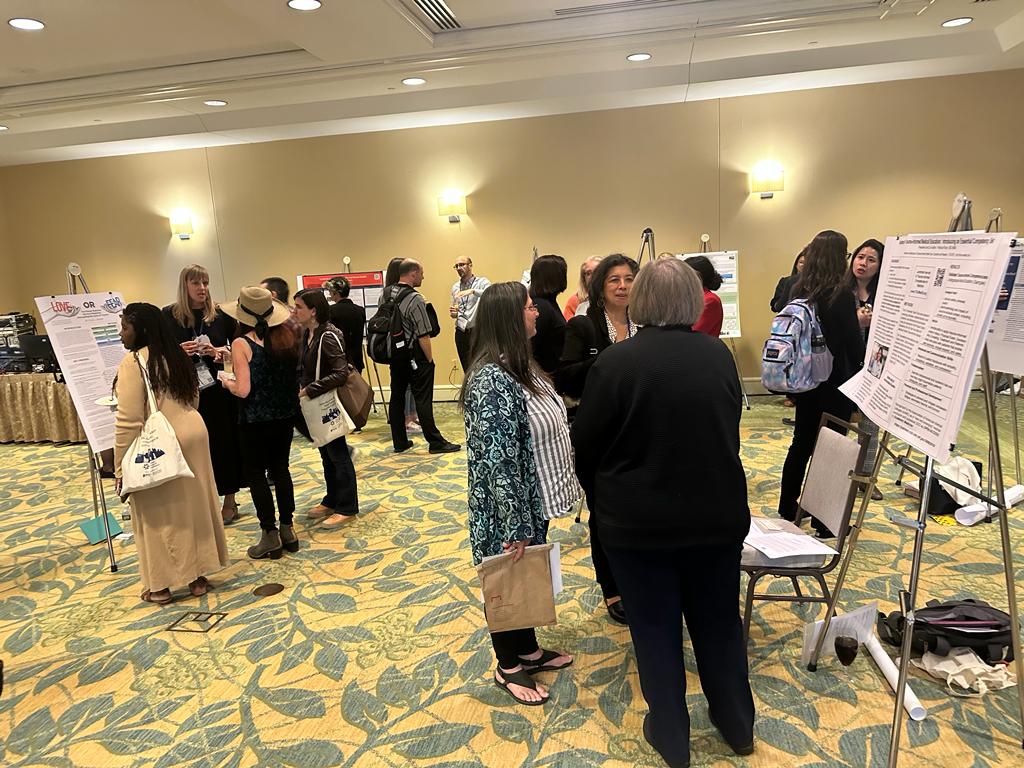
The goal of the Poster Session is to promote an exchange between researchers and clinicians and help people who feel intimidated by jumping into research see how much fun they can have. Our field grows and thrives when we make space for more voices and knowledge. The crowd is lively, the conversation is warm, and this is a great chance to practice sharing what you know.
Thank you to each of our Poster Session Presenters and their incredible work!
Peter Mayfield – Out of the Clinic and Into the Woods: The efficacy of nature-based therapeutic mentoring for Latinx and Under-resourced Youth Suffering From Complex Trauma
Ramnik Dhingra – Development of an LGBTQ Identity Under Attack: Healing Centered Approach
Dr. Mays Imad (with students: Sophie Barr & Jack Howell) – Investigating the Impact of Biofeedback and Self-Compassion Trainings on Anxiety Among College Students
Hsin-Chun Wu – Integration of the Therapeutic Power of Play into Adult Complex Trauma Treatment
Cloe J. Aigner – Love or Fear? The Please/Appease Survival Response: Interrupting the Cycle of Trauma
Ceclin Kirsty Begbie – Journeys of Recovery From Sexual Assault Trauma: Exploring the Perceived Lived Experiences Which Aided and Hindered the Recovery of Rape Survivors in South Africa
Zeynep Guney – Scholar-activism, political oppression, and mental health: Academics for Peace
Pamela Segura – ACEs, Emotion Regulation, and Suicide Behaviors among Ethnoracially Minoritized Youth
Ellen Yates and Anna Sanford – Expanding the Scope of Vicarious Trauma: Dissociation & Self-Dehumanization as Predictors Across Trauma-Exposed Career Fields
Stephen Kirsch – Say My Name, Say My Pain
Dr. Edward Mooney Jr. – The Trauma Cascade in Education
Michelle Jeffers – The DE-CRUIT Program: Treating Veterans’ Trauma Through Shakespeare
Alana Lee – STARS (Sexually Traumatized Adolescents Recovery from Substances) Program
Hunter Crespo – Parents’ Unresolved Abuse and Their Children’s PTSD Status
Chloe Gehl – The Effects of Post-Incarceration Syndrome (PICS) on Incarcerated Individuals
Dr. David G Bullard – Limitations of Evidence-Based Psychotherapies for PTSD and A New Clinical Paradigm
We offer: Life-changing Professional Development – Educators increase their understanding of stress behavior, how to address it in the moment, and diminish its frequency. In-person or virtual options available. Easy-to-use Guidebook and Sensory Toolkits- Our guidebook & tools bring a greater sense of felt safety and joy to the classroom.
A Non-Profit Organization Connecting Knowledge with Need
Since 1979, PESI Inc., has provided cutting edge continuing education to professionals across the nation. We work alongside the world’s leading experts to create seminars, conferences, videos and books that meet the needs of adult learners. All of our continuing education seminars and products assure that professionals can meet the changing demands of their work by providing practical strategies, methods and interventions they can use immediately to improve the outcomes of their clients.
As a non-profit organization, our mission is to educate and instruct the general public, public organizations, private industry, students and professionals to assist them in acquiring, developing and enhancing their knowledge and skills, and to assist other charitable and educational organizations in the conduct of similar activities. We have the most robust continuing education library available anywhere. You can attend one of our live seminars in all 50 states and you can access our products and digital library anywhere in the world at any time you need new information to help your clients or if you have a credit deadline looming.
Located in Eau Claire, WI, PESI is proud to have over 100 employees dedicated to the highest quality content, products and events. We are so confident in the quality of our events and products that we stand behind them with a 100% satisfaction guarantee. Chances are, the people you studied in graduate school and the author of the latest professional book you read, have continuing education offerings through us. We are also proud partners with many of the nation’s leading conferences, publishers, associations and institutes to help them connect the latest evidence-based content to you.
A leader in the industry, Meadows Behavioral Healthcare is a network of specialized programs including inpatient, residential, and outpatient treatment for trauma, substance use disorder, eating disorders, sexual addiction, behavioral health conditions and co-occurring disorders, as well as a whole range of workshops and standalone Brain Centers offering state-of-the-art neurofeedback and other services. Our evidence-based approach is guided by world-renown Senior Fellows and rooted in decades of clinical experience.
The Renfrew Center has been the pioneer in the treatment of eating disorders since 1985. As the nation’s first residential eating disorder facility, now with 19 locations throughout the country and virtual treatment available in 30+ states through Renfrew@Home, Renfrew has helped more than 100,000 individuals with anorexia, bulimia nervosa, binge eating, as well as the full range of eating disorders move towards recovery. Renfrew’s extensive range of services includes Residential, Day Treatment, Intensive Outpatient, Outpatient Programs, and Virtual Therapy. Each treatment level is built upon The Renfrew Center Unified Treatment Model for Eating Disorders®, an evidence-based, emotion-focused therapy that addresses eating disorders and co-morbid symptoms. Within this model, individual and group therapy are enhanced with a diverse array of services to meet patients’ needs. Renfrew accepts most major insurances and is a preferred provider for all levels of treatment.